
From across the room it reads like a neon sign. Up close it turns out to be a wall of thousands of small orange rocker switches, the kind you find on a power strip, each one lit or dark, and together they spell out two words: Hello World.
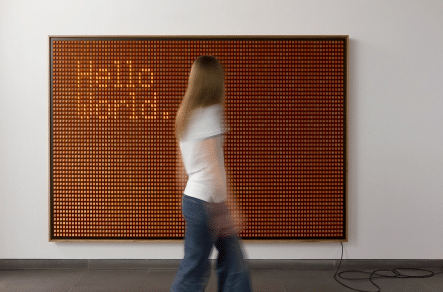
Untitled (Hello World) is a site-specific installation by the Austrian artist Valentin Ruhry, shown in 2011 at the Austrian Cultural Forum in New York as part of the group exhibition Fünf Räume. Depending on who counted, the board holds between 4,750 and 5,000 switches, every one of them a pixel.
The title is a programmer’s joke. “Hello, World!” is the first thing almost everyone writes when learning a new programming language: a tiny program whose only job is to print those two words on the screen, proof that the machine is listening. Ruhry takes that private moment and blows it up to the size of a wall, built from the most ordinary piece of electrical hardware there is.
That is what makes the piece still feel fresh: no screen, no code you can see, only a low-tech grid of on and off doing what every display does, one bit at a time. It is a greeting from the machine to the room, and a reminder that every image we look at on a screen is, underneath, a very long list of switches.
Free newsletter, every Sunday
The Week on Feel
The best of the week in design, architecture and art, picked by our editors and delivered to your inbox.