

At first glance it looks like a trick of the lens, as if someone had squeezed the photo sideways. Two ordinary cars sit in a car park, and in the gap between them, where you would expect a bicycle at most, there is a bright blue Fiat Panda. Same boxy nose, same flat glass, same unmistakable tailgate. Only about a third of the car is missing.
This is Panda per Uno, Panda for One, built by Andrea Marazzi, a mechanic from Bagnolo Cremasco, near Cremona. Guinness World Records has certified it as the world’s narrowest drivable car: it measures just 50.2 cm across, less than the width of a standard doorway, and it appears in the new Guinness World Records 2027 book.

Cut down the middle
The donor was a clean 1993 Panda that arrived in 2024 at Autodemolizione Marazzi, the family’s scrapyard. Hundreds of Pandas had passed through the yard over the years, so Marazzi knew the car by heart. He removed the doors and side panels, then sliced the body lengthwise through the centre and welded the two halves back together. According to Marazzi, the hardest part was cutting the frame so that the two sides would match perfectly once rejoined.
He then fabricated a new bonnet, roof, tailgate and windows to fit the slimmer body, and left everything else as it was. Around 90 percent of the car still comes from the original Panda. Underneath, a small electric motor and battery pack replace the old engine, the steering gear has been shrunk to match, and the lights and indicators work. Top speed is 15 km/h, which is probably wise: by Guinness’s own admission, it is not the most stable thing around a corner.

A cult object, taken literally
The choice of car is not accidental. Designed by Giorgetto Giugiaro and launched in 1980, the first Panda was itself an exercise in reduction: flat panes of glass, simple panels, an interior stripped to the essentials. It was 3.38 m long and 1.46 m wide, made for the narrow streets of Italian old towns, and Fiat built around 4.5 million of them before production ended in 2003. Today it has a devoted following, with its own yearly gathering, Panda a Pandino, held in the nearby town of Pandino, where Marazzi first showed his project.
Panda per Uno is not alone there. Marazzi’s friends of the Carmagheddon collective have built a Panda Corta with a one metre wheelbase, and Marazzi has since grafted a Panda body onto the running gear of a 1980s Landini tractor. The mechanical simplicity of the old car, and the steady supply of scrapped examples, make it the ideal base for this kind of playful surgery.
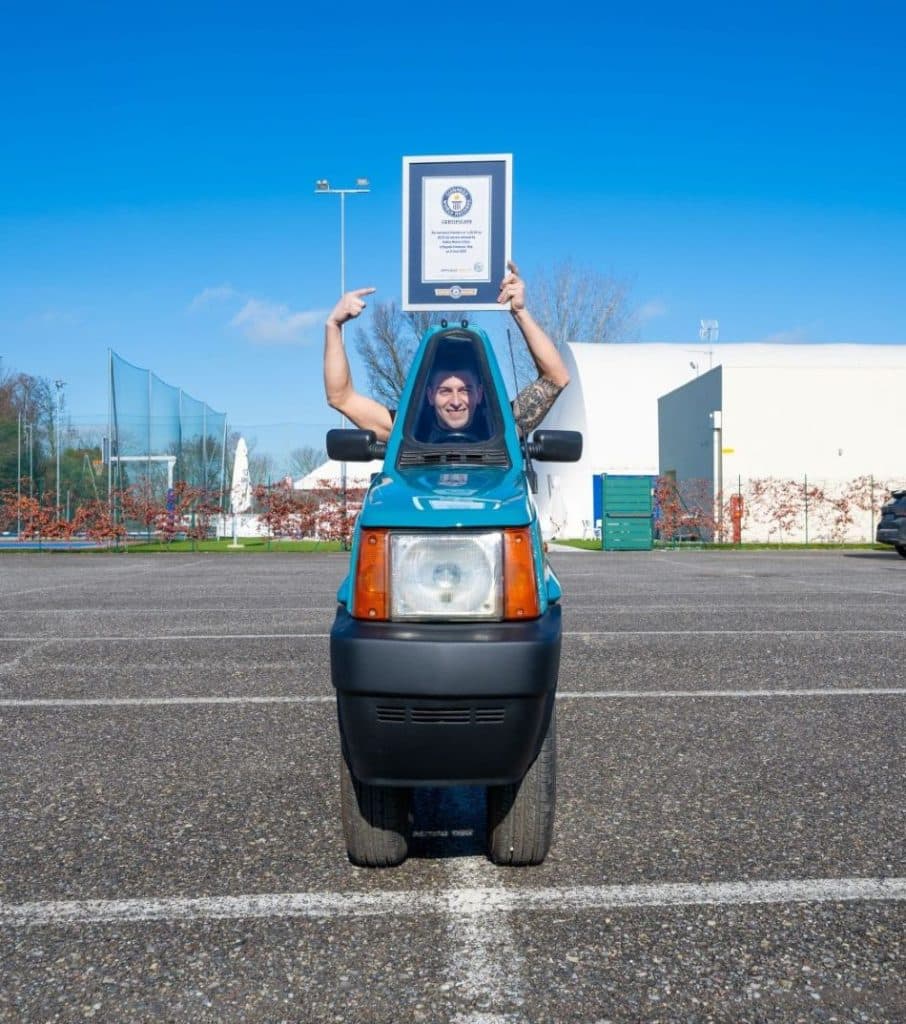
It is a one off, it is not meant for the road, and nobody is suggesting a narrow car revolution. But we find it a surprisingly good lesson in industrial design. Strip away two thirds of the width and the Panda is still instantly a Panda: the proportions of the nose, the angle of the windscreen, the plain tailgate carry the whole identity on their own. Few cars could survive that kind of cut and remain recognisable. Giugiaro’s box, it turns out, works even at 50 centimetres.
Project: Panda per Uno
Design: Andrea Marazzi
Location: Bagnolo Cremasco, Italy
Images: courtesy of Guinness World Records
Via: Guinness World Records, DesignTAXI