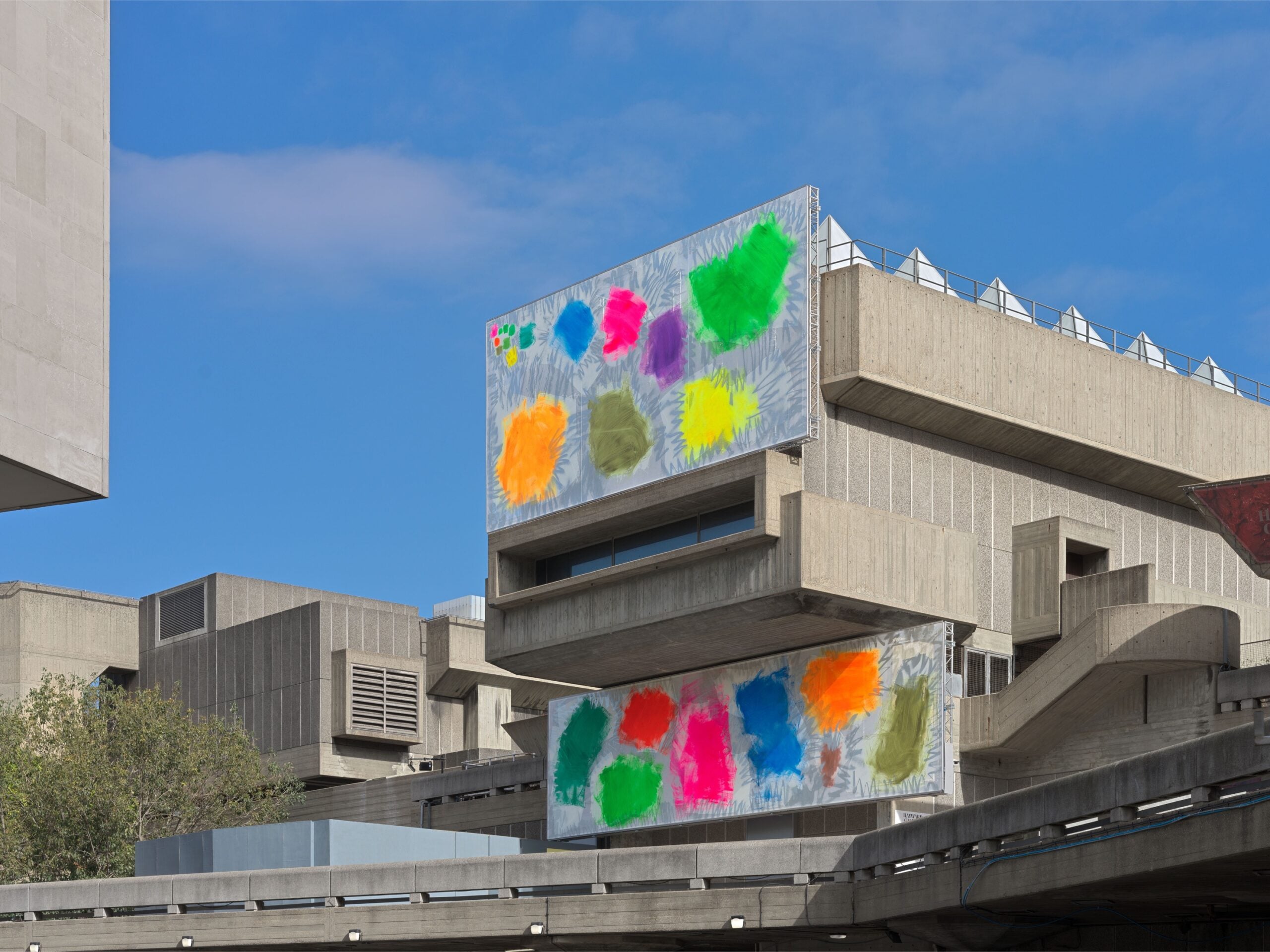
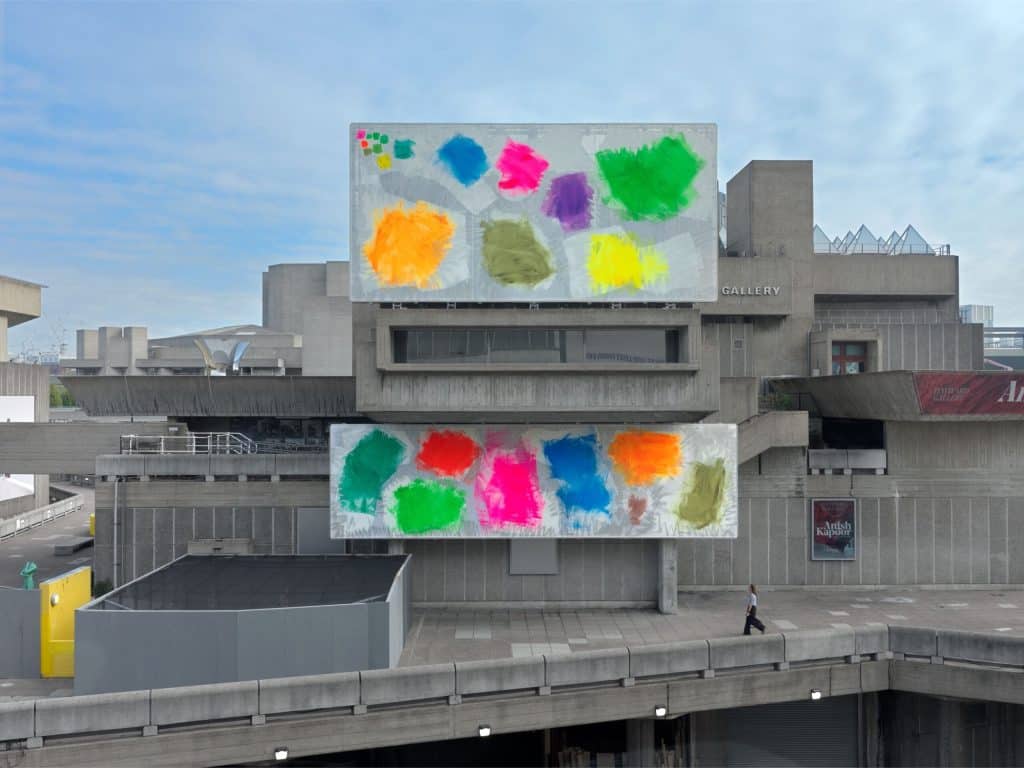
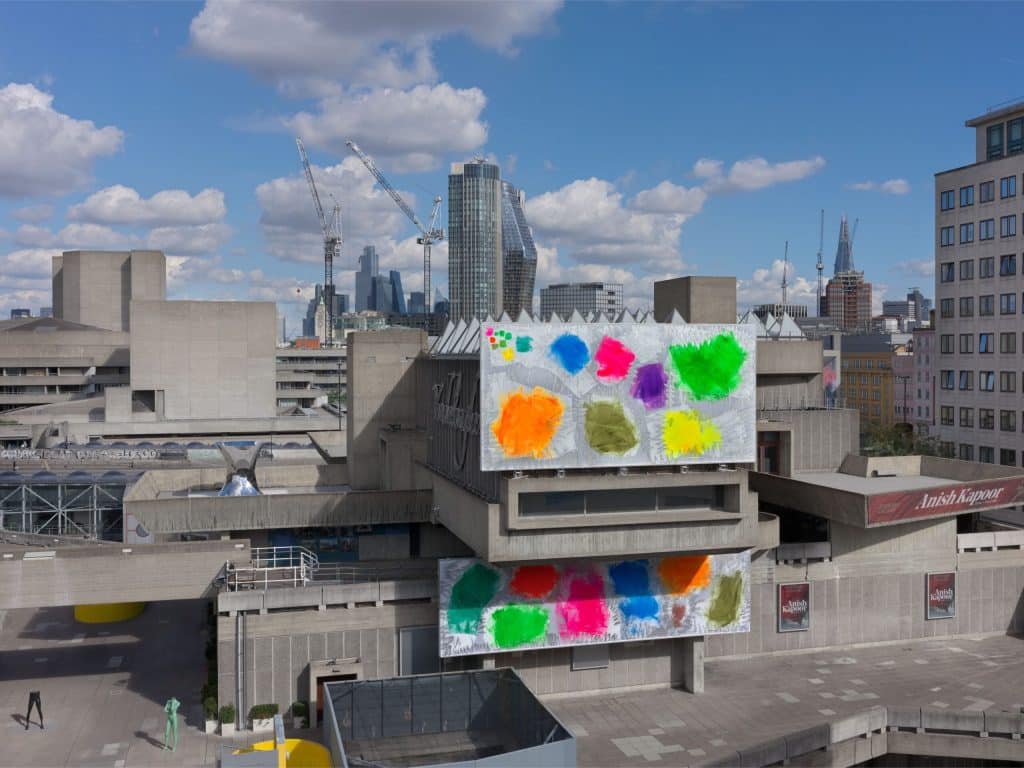
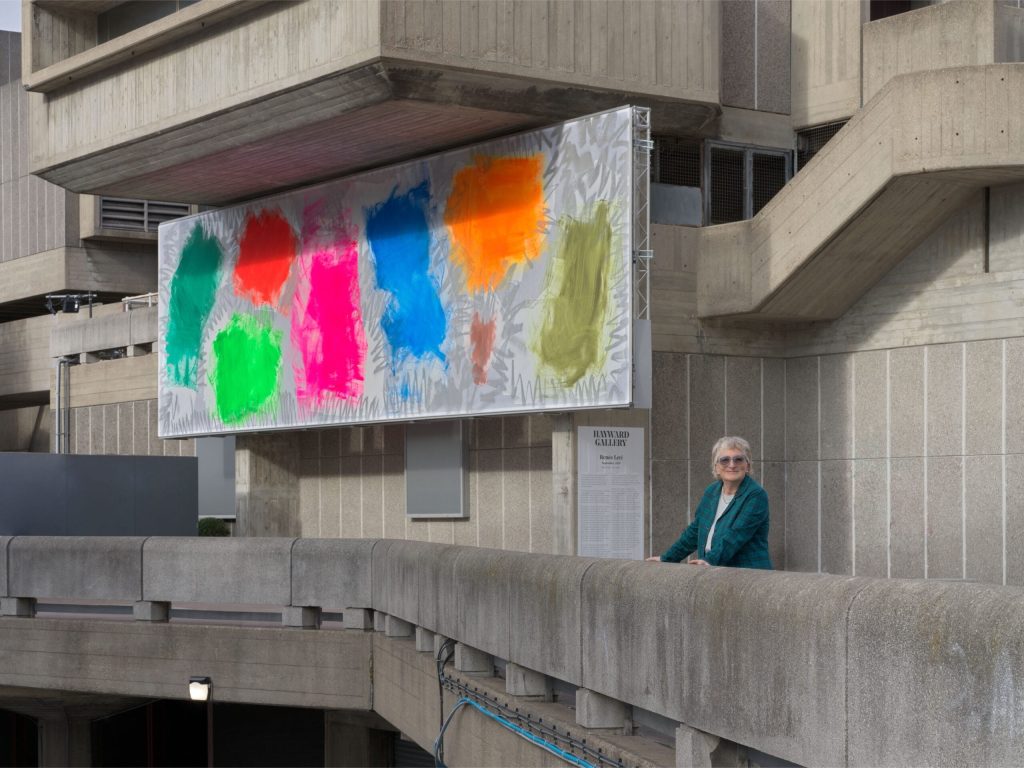
Walk along the South Bank these days and the grey concrete of the Hayward Gallery has company. Two long white panels, one above and one below the horizontal window that juts out of the building, are covered in soft, rough edged patches of fluorescent pink, orange, green, blue and yellow, like colour samples blown up to the size of a billboard. The work is called September, and it is the first large scale public piece in the UK by Swiss artist Renée Levi.
Co-commissioned by the Southbank Centre’s Hayward Gallery and Audemars Piguet Contemporary, the art programme the Swiss watchmaker launched in 2012, the painting was unveiled on 23 September and will stay on the facade until 15 November. Eight weeks, then it comes down.
Starting from the eye
Levi did not treat the facade as a backdrop. Her starting point was the building itself, and in particular that projecting rectangular window, which she calls the “eye” of the Hayward. The painting is organised around it, above and below, as a single gesture split in two. The protrusions, openings and proportions of the gallery set the size and geometry of the work, so that the painting ends up absorbing the character of the architecture rather than covering it.
It is not a neutral wall to work on. Opened in 1968 and protected as a Grade II listed building, the Hayward is one of the most recognisable pieces of brutalism in London, all exposed concrete and stacked volumes, with a facade that already behaves like a sculpture. Its raw surfaces have hosted artists before, but rarely with something as plain, and as disarming, as paint.
A mop, a body and an industrial mesh
The technical choices are what make the project interesting from a design point of view. The panels borrow the format of the billboard, and the material too: for the first time Levi painted on industrial mesh, the kind normally used for large scale signage, a support built to cope with the strong winds the building is exposed to. The work was produced in modular sections and assembled on site.
The marks themselves stay human in scale. Levi uses her own body as a unit of measure and paints with a mop about a metre long, so no stroke is bigger than the reach of a moving arm. On a building of this size the effect is curious: from across the river you read a monumental composition, up close you read the trace of a person working fast. And since the panels sit at different heights and angles, the painting can never be taken in at a single glance. You catch it in pieces, walking by.
None of this comes out of nowhere. Born in Istanbul in 1960 and based in Basel, Levi trained as an architect at HTL Muttenz before studying at the Zurich School of Art and Design, and for more than thirty years her work has dealt with the relationship between painting, space and architecture, often directly on walls. She received the Prix Meret Oppenheim in 2002 and won the competition for a public artwork at the Federal Palace in Bern.
September is also a first for Audemars Piguet Contemporary. The programme has commissioned installations, sculptures and performances from artists such as Cao Fei, Ryoji Ikeda, Tomás Saraceno and Adrián Villar Rojas, but never, until now, a painting.
A woman’s name
The title works on two levels. September is the month when the light, the weather and the pace of the city change, which suits a piece meant to be seen in passing, at different hours, in sun and in shade. But in English September is also a woman’s name, and Levi gives female names to all her paintings: a small, deliberate way of keeping in view the many women artists that art history has sidelined, forgotten or simply written out.
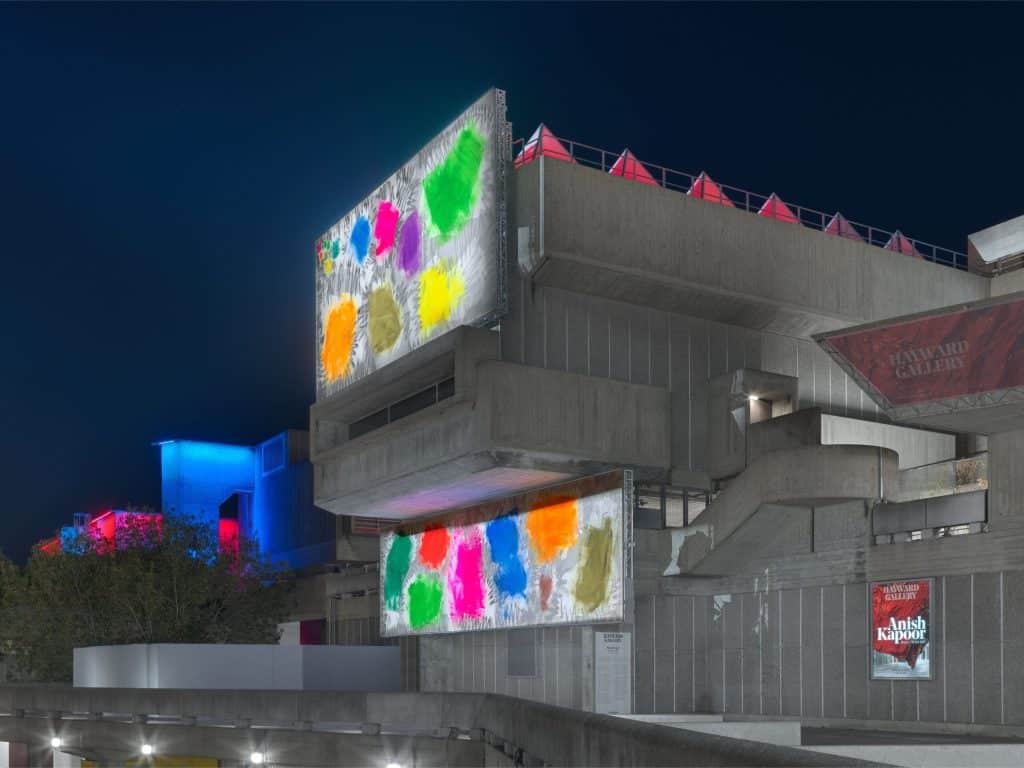
We find it a quietly generous piece of public art. No projection, no screen, no slogan, just colour applied by hand to one of the most familiar concrete faces in London. Commuters will probably stop noticing it after a couple of weeks, and then miss it the morning it is gone. Which, if we read the artist correctly, is exactly the point.
Project: September
Artist: Renée Levi
Commissioned by: Hayward Gallery, Southbank Centre, and Audemars Piguet Contemporary
Location: Hayward Gallery, Southbank Centre, London
Dates: until 15 November 2026
Images: courtesy of the artist, the Southbank Centre’s Hayward Gallery and Audemars Piguet
Via: Artribune, designboom, Audemars Piguet