
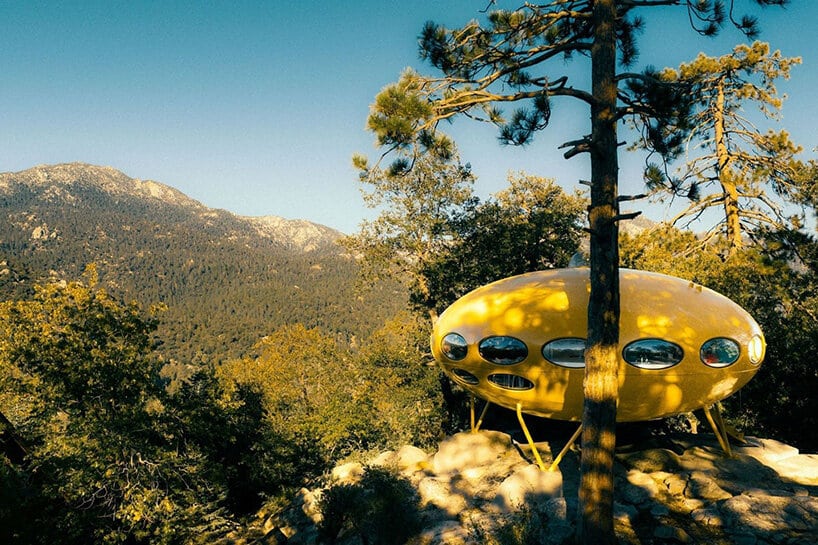
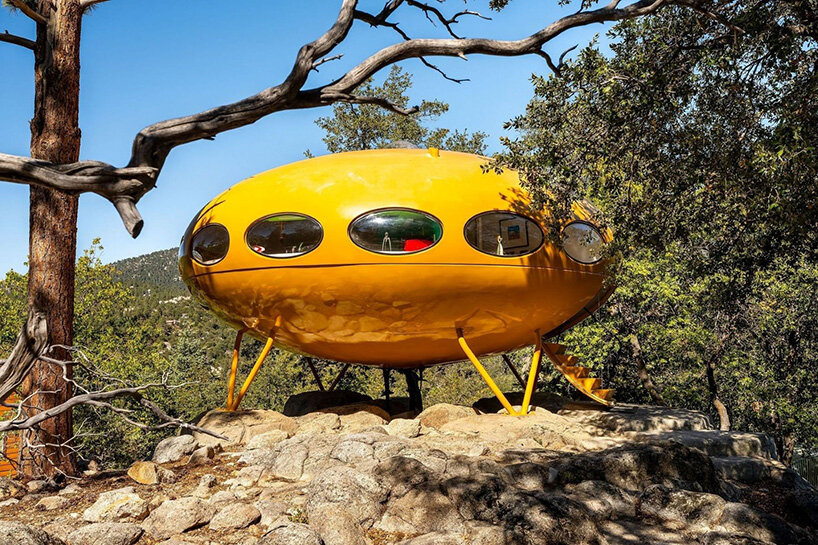
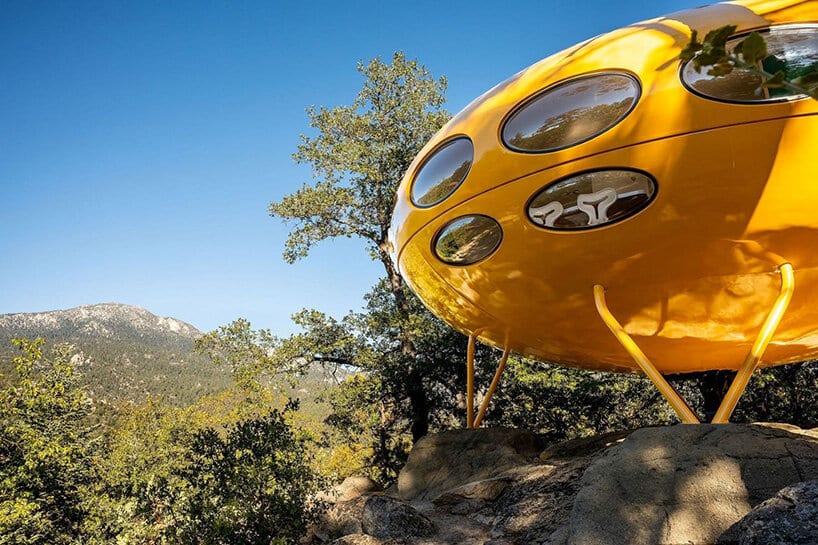
Perched on a granite outcrop in the San Jacinto Mountains, among the pines, a mustard yellow ellipse hovers on a ring of steel legs. Sixteen oval windows run around its rim like the portholes of a ship that took a wrong turn somewhere over Riverside County. A hatch folds down into a staircase. Nobody is getting abducted. Someone, however, is about to get a very unusual house.
This is the Donaldson Futuro, built in 1969 to a design by Finnish architect Matti Suuronen, and Desert Sotheby’s International Realty has just listed it for $1,495,000. It was the first Futuro ever to reach California and is still the only one in the state with a permit to be lived in. It is also on the National Register of Historic Places and is California Historical Landmark No. 1062, which is more paperwork than most flying saucers ever get.
The ski cabin that wanted to be the future
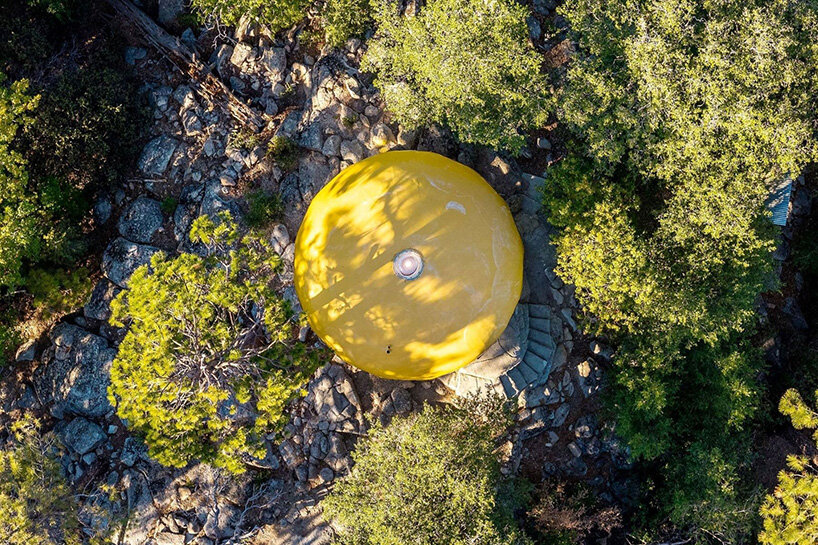
It started with a modest brief. In 1965 Suuronen sketched a ski cabin for a friend: something that could sit on steep, uneven ground and warm up fast after a day on the slopes. What he came up with was a spheroid of glass fibre reinforced polyester, eight metres across and four metres high, made of sixteen moulded segments bolted together and raised on welded steel tubes. Four concrete footings were all it needed. It could be assembled in two days, or simply flown in by helicopter, and with polyurethane insulation and electric heating the interior went from minus 29 to plus 16 degrees Celsius in about half an hour. The prototype was shown to the press in March 1968 at the Polykem plant in Vantaa, and a world already caught up in the space race went a little giddy.
Licences went out to dozens of countries, with production in the United States, Australia and Belgium. Then came 1973. The oil crisis sent the price of petroleum-based plastics through the roof, and the miracle material of the decade began to look like an environmental problem. Add zoning boards, bank managers who didn’t quite know how to finance a spaceship, and the occasional vandal, and the Futuro was off the market by the mid seventies. Fewer than a hundred were made, and around sixty are thought to survive across some eighteen countries. The prototype, serial number 000, now belongs to the Museum Boijmans Van Beuningen in Rotterdam.
Rescued from the wrecking ball
This unit was built by Futuro Enterprises in Philadelphia and shipped west, where it ended up in a parking lot behind the San Diego Design Center, already dented by a wrecking ball. In the late 1970s preservation architect Milford Wayne Donaldson bought it for about $15,000, roughly what it had cost new. He and a team of specialists then spent two years in a boatyard refinishing the shell. That makes sense: structurally, a Futuro has more in common with a yacht than with a bungalow.
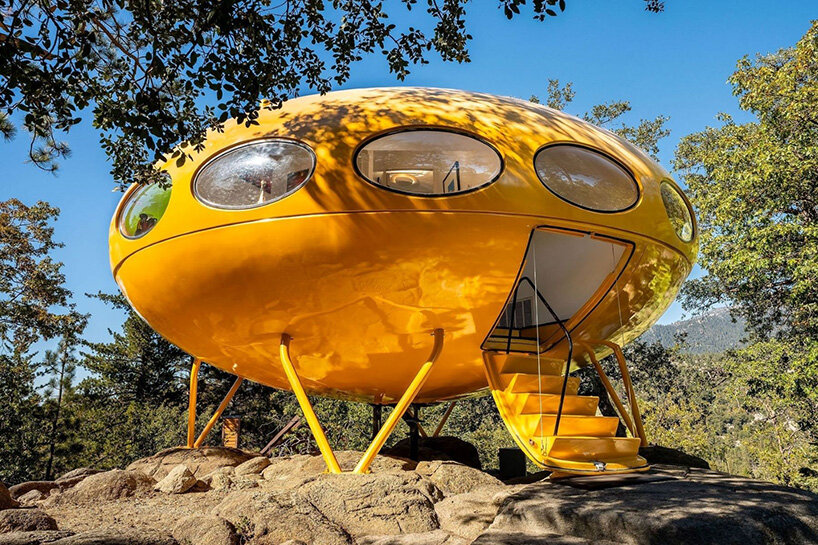
Donaldson’s day job adds a nice twist. He went on to serve as California’s State Historic Preservation Officer and later chaired the federal Advisory Council on Historic Preservation. So the man in charge of safeguarding American heritage kept a fibreglass UFO of his own, and we find that rather reassuring.
In 2003 Donaldson and his wife Laurie bought half an acre in Pine Cove, near Idyllwild. In December 2004 the house, all 5,400 kilos of it, travelled up the mountain under a California Highway Patrol escort and was lowered onto its granite perch by crane.
Inside the saucer
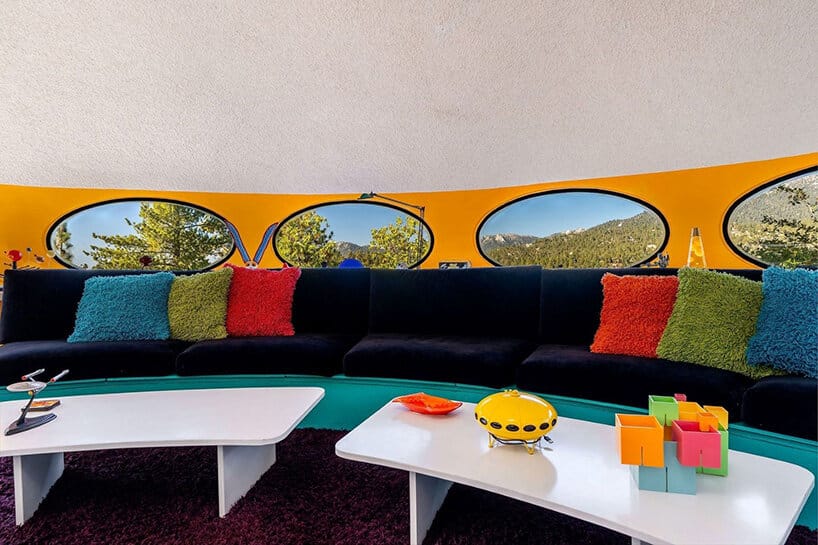
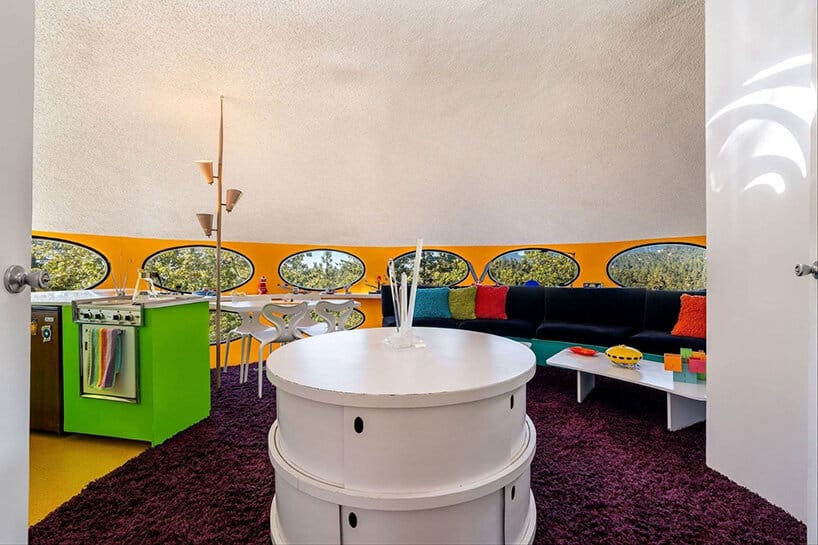
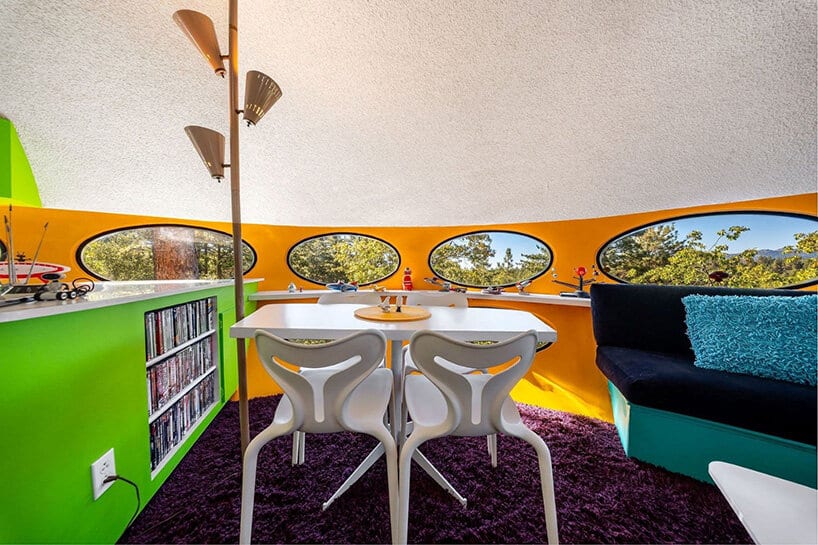
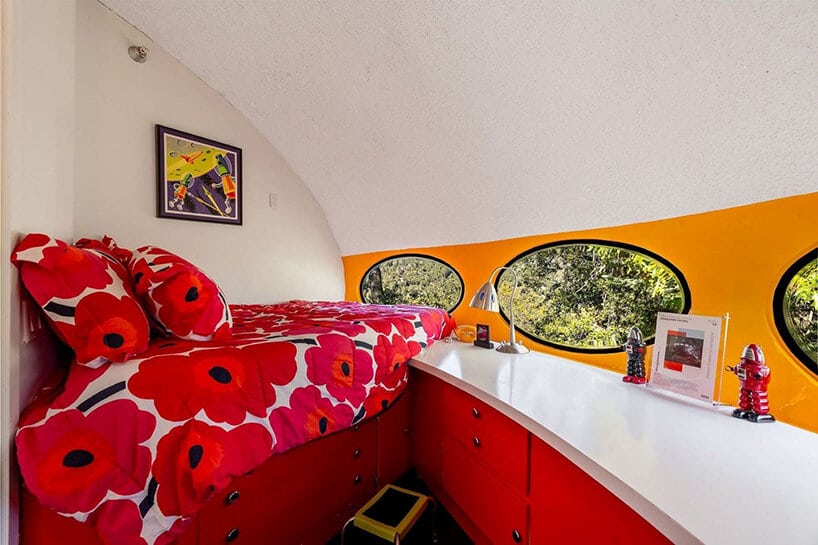
The interior is pure period confidence: purple shag carpet, a compact lime green kitchen with custom cabinetry, a teal accent wall, red built-ins in the bedroom and a gold flecked popcorn ceiling (asbestos free, we’re told). Built-in seating curves along the perimeter, following the shell, while partition walls carve out a bedroom and a bathroom. The old flue opening is now a skylight. It’s about fifty square metres, with one bedroom and one bath, and it’s sold furnished.
Why it matters
It’s tempting to file the Futuro under kitsch, somewhere between lava lamps and inflatable chairs. That would be a mistake. Suuronen’s capsule was one of the first serious attempts at a mass-produced, transportable plastic house, and its questions (how light can a house be, how fast can it go up, how little ground does it need to touch) are the same ones prefab and modular architecture are still asking today. The National Register listing calls it “an example of America’s collective confidence as a leader in space flight.” We would add: confidence that the future could be bolted together over a weekend.
For $1.5 million, that confidence can be yours. No landing permit required.
Project: Donaldson Futuro, Pine Cove, Idyllwild, California
Design: Matti Suuronen (Futuro, 1968)
Built: 1969, Futuro Enterprises, Philadelphia
Listing: Desert Sotheby’s International Realty, $1,495,000
Images: courtesy of Desert Sotheby’s International Realty
Via: designboom
Read also: SANU’s timber cabins scattered across rural Japan and Tini, a prefabricated home office cabin by Delavegacanolasso